|
Mission Spotlight
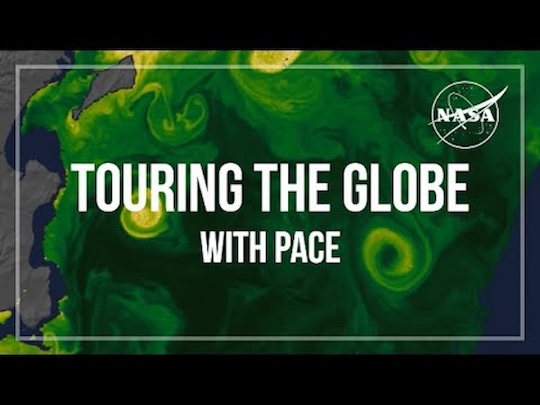
New NASA Views of Earth, From (S)PACE
To dig into the mysteries of our planet Earth, NASA has a fleet of satellites in orbit, gathering data around the clock. Join one of these satellites — the Plankton, Aerosol, Cloud, ocean Ecosystem satellite (PACE), which launched in February 2024 — to explore its unique views of our home planet's ocean, atmosphere, and land surfaces.
Read more »
Mission Updates
Data Processing Updates
|
COMPLETE
SPEXone and HARP2 V4 Level-1C Reprocessing
The PACE Science Data Segment recently completed a reprocessing of the SPEXone and HARP2 Level-1C products. This V4 reprocessing is a significant update of the calibration for both sensors, which greatly improves radiometric consistency across sensors as well as performance of geophysical retrieval algorithms.
Available Data Collections:
Forward stream production of V3 L1C has now ceased, and the existing collection will be staged for deletion after a brief waiting period. Reprocessing of Level-2 and Level-3 polarimetry products utilizing the V4 calibrations (V4.0) is expected to commence in the coming weeks, including RemoTAP and MAPOL aerosol and ocean color products from SPEXone, and MAPOL and GPC aerosol, ocean color, and cloud products from HARP2.
Release notes:
|
|
COMPLETE
OCI V3.2 Ocean Color Products Reprocessing
The V3.2 reprocessing of all OCI ocean color products was recently initiated to correct some recently identified algorithm implementation errors, resulting in reduced cross-scan artifacts. Collections include Ocean Color AOP, IOP, BGC, Phytoplankton Community Composition (MOANA), Net Primary Production (NPP_Cafe) and PAR.
|
Key Change in V3.2:
Global Level-3 Mapped products for the AOP, IOP, and BGC suites are now provided as one mapped file per suite.
|
More details:
|
|
Data Access
V4 L1C and V3.2 L2/3/4 products available via:
|
|
|
Products are slowly making their way to the NASA EarthDataCloud (EDC).
|
|
Earthdata Web Unification
NASA Earth science data sites are being consolidated under the
Earthdata domain
from now until end of 2026, which will impact
Ocean Color Web
resources. Thank you for your patience as we make this transition.
Learn More »
|
|
How is the PACE Ocean Color Instrument (OCI) performing?
The PACE OCI Calibration Team continuously evaluates the on-orbit radiometric performance of OCI.
View OCI Trending Plots »
|
|
PACE in Action
See how PACE data is being used around the world to advance ocean science and applications.
|
|
science.nasa.gov
Off Uruguay, PACE Partners Connect Data from Satellite and Sea
PACE partners combine satellite observations with in-situ ocean measurements off the coast of Uruguay, connecting data from space and sea.
Read More »
|
|
|
|
science.nasa.gov
Sailing for Science: A 50-Day Mission to Study the Southern Ocean
Scientists embark on a 50-day sailing mission to study the Southern Ocean, collecting data that complements PACE satellite observations.
Read More »
|
|
Community Showcase
Celebrating our community of researchers, educators, and ocean science enthusiasts who use PACE data to advance our understanding of Earth's oceans.
|
NEW WORKING GROUP
New NOAA Fisheries & Ocean Ecosystems Working Group
The Fish-PACE User Group serves as a forum for connecting, supporting, and growing the fisheries and ocean ecosystem user community around NASA's PACE mission and new ocean color products, with the goal to advance applications for fisheries, marine ecosystems, and coastal decision-making.
Learn More »
|
|
EDUCATION
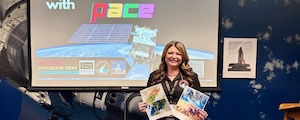
Bringing PACE Into the Classroom
By Lisa Stewart
Read More »
|
|
OCEAN CARBON
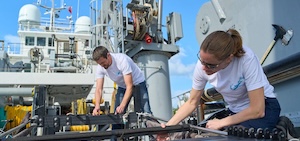
PACE is BATS for Ocean's Carbon Story
By Sara Blumberg
Read More »
|
|
|
Calling QGIS Users: Help Shape a Free PACE + QGIS Training Course!
A new free, asynchronous course is in development at
Ocean Science Analytics,
a PACE Early Adopter, to help the ocean science community work with NASA PACE satellite data in
QGIS.
To sync content and community needs, we are asking anyone with an interest in PACE data (even if you have not used it yet) across all sectors and experience levels to complete a short 5–8 minute survey. Your responses will directly shape what topics and data products the course prioritizes.
All responses are anonymous.
|
|
SHARE YOUR PACE STORY!
We're collecting stories to highlight the real-world value of PACE
across public and private sector science and
applications efforts worldwide.
Share your research
breakthroughs, creative applications, or inspiring discoveries.
We want to help spread the word about your impact!
Connect with us at:
[email protected]
|
Upcoming Events & Opportunities
Don't miss these upcoming conferences, workshops, and opportunities to connect with the PACE community.
|
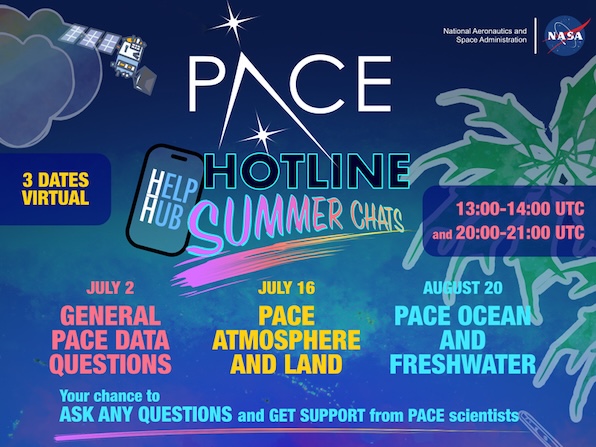
July 2, July 16 & Aug. 20, 2026 |
Help Hub Summer Hotline Series | Virtual |
July 2: General PACE data Questions |
July 16: PACE Atmosphere and Land |
Aug. 20: PACE Ocean and Freshwater |
Register Now » |
|
Postponed, date TBD |
Fish-PACE Onboarding: Intro to earthaccess Python package and on-boarding to the CryoCloud JupyterHub for Fish-PACE members |
Register (all welcome!) » |
|
July 10, 17, 24 & 31, 2026 |
CoastWatch Satellite 201 Summer Lecture Series | Virtual, free to all | Fridays 11am-1pm (Pacific Time). July 17th: Ryan Vandermeulen presents on PACE products beyond Chlorophyll for fisheries and ocean ecosystem applications |
Register » |
|
Aug. 24-28, 2026 |
OceanHackWeek 2026 | Bamfield Marine Sciences Centre, BC, Canada | Applications open May 15. Eli Holmes (NOAA) will mentor a Fish-PACE focused project. Great event for early career scientists |
Learn More and Apply » |
|
Sept. 3, 2026 |
PACE Community Quarterly Telecon: Air Quality Monitoring from Space |
|
|
Watch your PACE Community email & our
Events page for PACE community event news!
|
|
Opportunities
|
Apply Now |
2026 James E. Cloern Early Career Publication Honor – Previously known as the Limnology & Oceanography Letters Early Career Publication Honor. Pays the publication cost of open-access articles authored by students and early career professionals in need. |
Apply Now »
|
|
PACE in the News
People are talking about PACE!
|
|
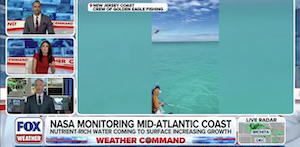
foxweather.com
Caribbean Colors Invade the Jersey Shore: Massive Phytoplankton Bloom Turns Atlantic Turquoise
A massive phytoplankton bloom turned the Atlantic Ocean turquoise off the Jersey Shore, with NASA's PACE satellite capturing stunning imagery of the phenomenon.
Watch Story »
|
|
|
|
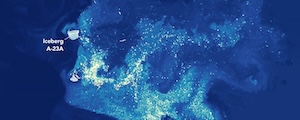
earth.com
After 40 years, 'megaberg' triggers massive phytoplankton bloom before vanishing forever
The iconic Antarctic iceberg A-23A triggers a massive phytoplankton bloom as it melts, captured by NASA's PACE satellite.
Read More »
|
|
|
|
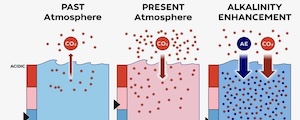
cleantechnica.com
Geoengineering The Gulf Of Maine
PACE data contributes to ocean geoengineering research in the Gulf of Maine, providing unprecedented detail on marine ecosystem dynamics.
Read More »
|
|
|
|
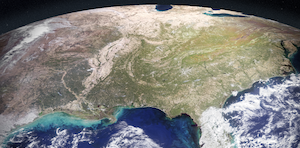
nasa.gov
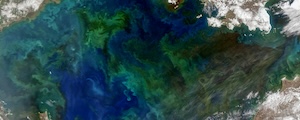
NASA-developed AI Could Help Track Harmful Algae
A new NASA-developed AI system leverages PACE satellite data to track and predict harmful algal bloom events with unprecedented accuracy.
Read More »
|
|
|
|
seafoodsource.com
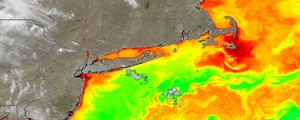
NASA to provide satellite data for fisheries research in new partnership
NASA announces a new partnership to integrate PACE satellite data into fisheries research and marine ecosystem monitoring.
Read More »
|
|
|
|
earthdata.nasa.gov
Spring Has Sprung in the Northwest Atlantic
PACE captures the arrival of spring in the Northwest Atlantic through stunning imagery of seasonal phytoplankton blooms and ocean color changes.
Read More »
|
|
|
|
earth.com
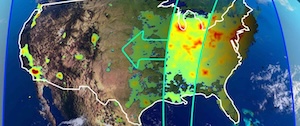
NASA satellite shows exactly where air pollution begins
PACE satellite data pinpoints the exact origin of air pollution sources, offering a powerful new tool for environmental monitoring and policy.
Read More »
|
|
|
|
colorado.edu
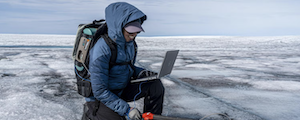
Using aerospace technology to study glacier melt in Greenland
Aerospace technology including PACE satellite observations is being used to study glacier melt dynamics in Greenland.
Read More »
|
|
Research Highlights
Discover the latest scientific breakthroughs and publications featuring PACE data. Researchers are pushing the boundaries of ocean and atmospheric science.
Help
Hub Corner
Satellite data processing can be difficult - we're here to help you climb out of that hole.

|
PACE Help Hub Hotline - Summer Chats
Your chance to ask ANY questions to PACE scientists and get support.
Learn more and register now!
|
|
|
Tools and Resources
|
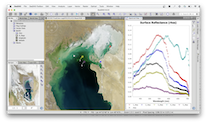
SeaDAS 11.0.0
We are pleased to announce the release of SeaDAS 11.0.0 that happened on April 13, 2026.
|
|
Highlights of what's new:
-
Improved Data Handling – Correct support for L3m datasets that cross the dateline, improved handling of HARP2 and SPEXone Level-2 products with 4D bands, and fixes for CZCS L2 image orientation.
-
Map Gridlines Enhancements – Improved rendering for global datasets and dateline-crossing scenes, with better labeling and performance for large-area visualizations.
-
Earthdata Cloud Spatial Subsetting – New OB_CLOUD Spatial Subset Tool retrieves Level-2 subsets from Earthdata Cloud via Harmony L2SS. Supports selection of individual 2D variables (e.g., chlor_a). Spatial subsetting preserves full data and should be used for quality-controlled analysis.
-
Enhanced OB_CLOUD Data Browser – Added "Regions" selector for bounded geographic subsetting and improved integration with the Spatial Subset Tool.
-
GPT Cross-Platform Support – Graph Processing Tool (GPT) now fully functional on Windows, macOS, and Linux.
-
Platform and Installer Updates – Integrated with SNAP 13 and Java 21. Installers available with and without bundled JRE for Windows, Linux, and Apple Silicon macOS. Intel-based Mac support has been discontinued.
SeaDAS and all related documentation are available on
NASA Earthdata.
Read Full v11.0.0 Release Notes »
|
PACE in Images
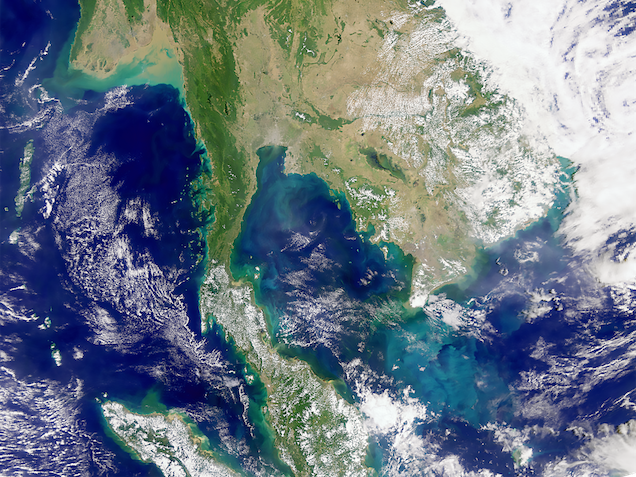
Gulf of Thailand & Andaman Sea
The Gulf of Tonkin is a semi-enclosed basin with Hainan Island (China) located to the southeast. Although the gulf is relatively shallow with a depth of...
Learn More »
|
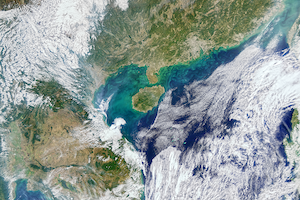
Gulf of Tonkin
The Gulf of Tonkin is a semi-enclosed basin with Hainan Island (China) located to the southeast. Although the gulf is relatively shallow with a depth of less than 100 m...
Learn More »
|
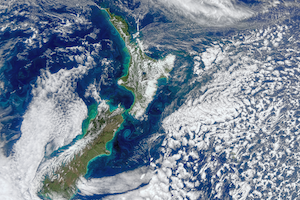
New Zealand Surrounded by Clouds
New Zealand's North and South Islands are surrounded by various types of clouds including icy high-level cirrus, open cell cumulus with a "bubbly" appearance...
Learn More »
|
Outreach & Engagement
The PACE team has been busy with outreach activities! Here are some highlights:
|
PACE Special Session at ForestSAT 2026
May 7, 2026 • Gainesville, Florida
PACE Applications and collaborators convened a special session at ForestSAT 2026 titled "Applications of NASA's PACE mission: new insights for ecosystem science." Speakers and session co-chairs included Skye Caplan, Fred Huemmrich, Morgaine McKibben, and Emil Cherrington, covering the PACE mission, terrestrial science applications, and data tools for Python, GIS, and Google Earth Engine users. A companion virtual pre-conference workshop on PACE spectral and land data was held earlier in the year.
|
|
ASPRS Mid-South Regional Conference
On March 30th, Morgaine McKibben gave a keynote presentation on "NASA's PACE Mission: Advancing Earth Observations and their Applications" at the ASPRS Imaging and Geospatial Information Society Mid-South Regional conference, hosted at Oak Ridge National Labs in Oak Ridge, TN.
|
ESA-ESRIN Sentinel 3 Validation Team Meeting
On March 31st, Violeta Sanjuan Calzado delivered an invited talk on "In-water AOP data requirements, workflows and results for PACE" at the ESA-ESRIN Sentinel 3 Validation Team Meeting in Frascati, Rome, March 30 - April 1.
|
|
ESA/JAXA EarthCARE Mission Hackathon
On April 20-24th, Sean Foley, Kirk Knobelspiesse, Anna Windle, Meng Gao, Chamara Rajapakshe, and Jeremy Werdell supported PACE mission participation in an
ESA/JAXA EarthCARE mission Hackathon
held at ESA/ESRIN in Frascati, Italy. The team gave a demo of
pace-earthcare-matchups (PEM),
a tool developed to find coincident PACE and EarthCARE observations.
|
Gulf of America Alliance
On May 4-7th, Bingqing Liu was invited to present in the Water Resources and Harmful Algal Bloom (HAB) sessions organized by the Gulf of America Alliance. The presentation showcased emerging applications of AI and PACE hyperspectral observations for monitoring harmful algal blooms, phytoplankton dynamics, and coastal water quality.
|
|
The Bishops School, San Diego
On May 7th, Bridget Seegers presented to 8th grade students at The Bishops School in San Diego, California. The presentation "Exploring Water" covered NASA Earth Science, ocean color research, and PACE mission data. Students explored a live and local plankton sample. The audience included over 100 students.
|
LP DAAC User Working Group
On May 18th, Bingqing Liu was invited as a new member of the LP DAAC User Working Group to share user experiences and recommendations for future data products. She highlighted the use of HyperCoast, an open-source platform for visualization and analysis of hyperspectral datasets including PACE observations.
|
|
Join the Library Scavenger Hunt Program
PACE team members have launched a new library-based scavenger hunt designed to introduce patrons to the fascinating world of phytoplankton.
|
Behind the Scenes
Meet the dedicated team members behind PACE who bring expertise and passion to our mission.
|
Early Career Spotlight
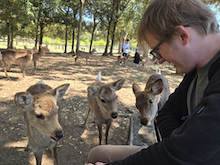
James Allen
James Allen was featured in NASA's Sciences and Exploration Directorate's Early Career Spotlight, highlighting his contributions to PACE science and his journey as an early career scientist at NASA Goddard.
Read Full Spotlight »
|
|
Get
PACE Swag!
|
Land's End Store - Always Open
Customize a wide array of garments with mission, instrument and agency logos
Shop now »
|
Newsletter Team
|
This newsletter is brought to you by the
PACE Applications and Communications Teams:
Carina Poulin, Morgaine McKibben, and Sara Blumberg
Have something for the PACE newsletter?
Contact us at [email protected]
|

|
National Aeronautics and Space Administration
NASA
Goddard Space Flight Center
|
|
|